- 1 hour 7 minutesCourt Strikes Down Trump ESA Regulations — A Win for Endangered Species

In a landmark ruling, a federal court in the Northern District of California struck down four of six challenged Trump administration regulations that had significantly weakened the Endangered Species Act’s core enforcement mechanisms. Host Mariann Sullivan speaks with Noah Greenwald, Endangered Species Program Director at the Center for Biological Diversity, about the case — what was challenged, what the court decided, and what it means for wildlife protection amid ongoing regulatory rollbacks under the current administration.
- Federal court invalidates four ESA regulations: The Northern District of California ruled that changes to Section 7 of the Endangered Species Act were both facially inconsistent with the statute and arbitrary and capricious under the Administrative Procedure Act.
- “Reasonably certain to occur” standard struck down: The court rejected a heightened evidentiary standard for evaluating effects of federal projects on listed species, restoring the lower “likely to occur” threshold that better reflects the statute.
- “As a whole” critical habitat language invalidated: Adding three words to the adverse modification standard would have allowed death-by-a-thousand-cuts destruction of critical habitat for wide-ranging species like the Northern Spotted Owl — the court found this directly contrary to the ESA.
- Enforceable mitigation commitments required: The court upheld that project proponents cannot escape ESA obligations through vague promises; terms and conditions to protect listed species must be binding and enforceable.
- Fish and Wildlife Service duty to flag reinstated: The ruling reaffirmed that FWS has an affirmative obligation to notify action agencies when consultation must be reinitiated — it cannot simply wash its hands of its expert role.
ABOUT OUR GUEST
Noah Greenwald is the Director of the Endangered Species Program at the Center for Biological Diversity, where he has worked since 1997 to protect imperiled wildlife, strengthen the Endangered Species Act, and raise public awareness about the biodiversity crisis facing North American wildlife.
We are thrilled to expand the accessibility of our podcast by offering written transcripts of the interviews! Click here to read this episode's interview.**********
 You can listen to the Animal Law Podcast directly on our website (at the top of this page) or you can listen and subscribe on Apple Podcasts, YouTube, or your favorite podcatcher. Also, if you like what you hear, please rate it on Apple Podcasts, and don’t forget to leave us a friendly comment! Of course, we would be thrilled if you would consider making a donation or becoming a member of our flock (especially if you’re a regular listener). Contributions of any amount will go towards our fundraising goal and are hugely appreciated. Our Hen House is a 501(c)(3) nonprofit organization, so it’s tax-deductible. Thank you for helping us create quality content!
Don’t forget to also listen to the award-winning, weekly signature OHH podcast — now in its fifteenth glorious year!
24 April 2026, 9:00 am - 1 hour 5 minutesCanada’s Live Horse Exports: Fighting for Animal Transport Law Enforcement w/ Camille Labchuk

When Canadian animal rights lawyer and Animal Justice Executive Director Camille Labchuk discovered that a Manitoba horse exporter had shipped 97 horses to Japan in December 2022 — on a rerouted flight projected to exceed Canada’s 28-hour transport limit and without a legally required contingency plan covering the full journey — she did something almost unheard of in Canadian animal law: she filed a private prosecution. In this episode, she and host Mariann Sullivan break down the brutal realities of Canada’s live horse export industry, the regulatory failures of the Canadian Food Inspection Agency (CFIA), and the historic trial that followed, with a verdict expected imminently.
- Canada’s live horse export industry exposed: A small number of Canadian exporters factory-farm horses specifically for live export to Japan, where the meat (basashi) is considered a delicacy, with individual shipments fetching over $1 million — yet most Canadians have no idea this industry exists.
- Systemic enforcement failures by the CFIA: Despite clear evidence of repeated violations of Canada’s 28-hour animal transport law and mounting data from Japan showing deaths, collapses, and serious injuries, the CFIA has never charged a single horse transporter — a pattern Animal Justice calls regulatory capture.
- A landmark private prosecution: Animal Justice used Canada’s little-known private prosecution right — rooted in British common law — to charge Carlisle Farms Limited for failing to have a legally required contingency plan covering the full duration of the horses’ journey to Japan, culminating in a two-day trial in Winnipeg in February 2025.
- The “Cruel Cargo” report: New data obtained from Japanese government and feedlot records reveals that in just one year, 9 horses died, 29 collapsed on flights, and 290 others suffered serious injuries or illness — none of which were reported by Canadian exporters or tracked by the CFIA.
- Legislative and legal momentum: A federal bill to ban live horse exports passed the Canadian House of Commons but died in the Senate; Animal Justice is now pushing the new Carney government to revive it, while also pursuing private prosecutions as a tool to force real enforcement of existing animal transport laws.
ABOUT OUR GUEST
Camille Labchuk is an animal rights lawyer and Executive Director of Animal Justice, Canada’s leading legal advocacy organization for animals, where she has spent over 15 years using litigation, investigation, and legislative advocacy to transform how Canada treats animals. Under her leadership, Animal Justice has secured landmark victories including the national ban on whale and dolphin captivity and the defeat of ag gag laws; she has argued cases at the Supreme Court of Canada, testified before legislative committees, and written for outlets including the Globe and Mail and the Toronto Star. A Fellow at the Oxford Centre for Animal Ethics, Camille holds degrees from the University of Toronto Faculty of Law and Mount Allison University, and brings a unique combination of legal and political strategy to the fight for animals — shaped by her earlier career as a press secretary to a federal party leader and two-time parliamentary candidate.
We are thrilled to expand the accessibility of our podcast by offering written transcripts of the interviews! Click here to read this episode's interview.**********
You can listen to the Animal Law Podcast directly on our website (at the top of this page) or you can listen and subscribe on Apple Podcasts, YouTube, or your favorite podcatcher. Also, if you like what you hear, please rate it on Apple Podcasts, and don’t forget to leave us a friendly comment! Of course, we would be thrilled if you would consider making a donation or becoming a member of our flock (especially if you’re a regular listener). Contributions of any amount will go towards our fundraising goal and are hugely appreciated. Our Hen House is a 501(c)(3) nonprofit organization, so it’s tax-deductible. Thank you for helping us create quality content!Don’t forget to also listen to the award-winning, weekly signature OHH podcast — now in its fifteenth glorious year!
27 March 2026, 9:00 am - 1 hour 5 minutesUnderstanding EU Farmed Animal Welfare with Dr. Neil Dullaghan

In this episode of the Animal Law Podcast, Mariann Sullivan sits down with Dr. Neil Dullaghan, political scientist and author of The Compassion Mandate: Remaking the European Union’s Leadership on Farmed Animal Welfare. Together, they explore the complexities and challenges of EU farmed animal policies.
This episode explores:
- The historical progress and current state of farmed animal welfare in the EU.
- The intricacies of EU governance and its impact on animal welfare legislation.
- Insights into the successes and setbacks of welfare reforms, including the influence of public activism.
- The potential for future improvements in animal welfare standards, particularly for farmed fish.
- The role of trade and labeling laws in shaping EU animal welfare policies.
Join us as we delve into the factors shaping the future of farmed animal welfare in Europe.
ABOUT OUR GUEST
Dr. Neil Dullaghan is a political scientist with a PhD in Political and Social Science from the European University Institute and an MPhil in European Politics and Society from the University of Oxford. He has led research projects on farmed-animal protection policy in the European Union as a senior research manager at the nonprofit, nonpartisan think tank Rethink Priorities.
We are thrilled to expand the accessibility of our podcast by offering written transcripts of the interviews! Click here to read this episode's interview.**********
You can listen to the Animal Law Podcast directly on our website (at the top of this page) or you can listen and subscribe on Apple Podcasts, YouTube, or your favorite podcatcher. Also, if you like what you hear, please rate it on Apple Podcasts, and don’t forget to leave us a friendly comment! Of course, we would be thrilled if you would consider making a donation or becoming a member of our flock (especially if you’re a regular listener). Contributions of any amount will go towards our fundraising goal and are hugely appreciated. Our Hen House is a 501(c)(3) nonprofit organization, so it’s tax-deductible. Thank you for helping us create quality content!Don’t forget to also listen to the award-winning, weekly signature OHH podcast — now in its fifteenth glorious year!
27 February 2026, 10:00 am - 1 hour 19 minutesA Case of Significant Evil: Animal Law, Activism, and Constitutional Rights

In this compelling episode, Mariann Sullivan interviews Wayne Hsiung and attorney Steffen Seitz about Wayne’s conviction following animal rescues at factory farms in California. The case hinges on several groundbreaking legal arguments, including the judge’s refusal to allow a necessity defense for rescuing suffering animals, constitutional concerns about the treatment of veganism as a belief system, and First Amendment implications for activist speech.
This episode explores:
- How the denial of a necessity defense prevented jurors from considering evidence of animal suffering that could have justified the rescue actions
- The legal argument that ethical veganism should receive First Amendment protection when it functions as a core belief system similar to a religion
- The constitutional problems with California’s overly broad “aiding and abetting” statute when applied to protected speech
- The growing support from prominent legal scholars and organizations like the ACLU, signaling a potential shift in how animal advocacy is viewed in legal circles
ABOUT OUR GUESTS
Wayne Hsiung is an animal rights lawyer, former faculty member at Northwestern School of Law, and co-founder of The Simple Heart Initiative. He has led teams that have investigated and rescued animals from factory farms and slaughterhouses across the globe and has organized successful campaigns to ban fur in San Francisco and California. He served as lead counsel (and, sometimes, defendant) in five “right to rescue” trials in which activists were prosecuted after being charged for giving aid to sick and dying animals, garnering media attention from The New York Times. He is also a co-founder and former lead organizer of the grassroots animal rights network Direct Action Everywhere. Wayne’s work has been covered by WIRED, ABC’s Nightline, and on The Ezra Klein Show. He has published on the right to rescue in Harvard Law Review and climate change’s impact on animals in the University of Pennsylvania Law Review. Prior to his work as an animal advocate, Wayne practiced law at two national firms and studied law and economics at the University of Chicago, where he was an Olin Law and Economics Fellow, and at the Massachusetts Institute of Technology, where he was awarded a National Science Foundation Graduate Fellowship. He is the proud parent of Oliver, who was rescued from the dog meat trade. Follow his work at simpleheart.org.
Steffen Seitz is a litigation fellow for the Animal Activist Legal Defense Project where he represents animal advocates and whistleblowers in a variety of proceedings and conducts academic research. Steffen graduated from Yale Law School in May 2023. As a law student, Steffen was a member of the Yale Animal Law Society and a Law Ethics and Animal Program Student Fellow. He also worked as a legal extern on animal activist cases, particularly those involving the right to rescue. Steffen is interested in criminal law, animal law, social movements, and their intersections.
We are thrilled to expand the accessibility of our podcast by offering written transcripts of the interviews! Click here to read this episode's interview.**********
You can listen to the Animal Law Podcast directly on our website (at the top of this page) or you can listen and subscribe on Apple Podcasts, YouTube, or your favorite podcatcher. Also, if you like what you hear, please rate it on Apple Podcasts, and don’t forget to leave us a friendly comment! Of course, we would be thrilled if you would consider making a donation or becoming a member of our flock (especially if you’re a regular listener). Contributions of any amount will go towards our fundraising goal and are hugely appreciated. Our Hen House is a 501(c)(3) nonprofit organization, so it’s tax-deductible. Thank you for helping us create quality content!Don’t forget to also listen to the award-winning, weekly signature OHH podcast — now in its fifteenth glorious year!
30 January 2026, 10:00 am - 54 minutes 20 secondsThe Case of the Lobster, a “Living, Sentient Creature”

In a bold legal challenge that could redefine animal protection law, PETA is taking on the Maine Lobster Festival for steaming 16,000 lobsters alive on public parkland. The case hinges on Maine’s unique animal cruelty statute that protects “every living sentient creature” – a definition that evolves with scientific understanding. PETA’s Director of Litigation, Asher Smith, explains their creative approach using public nuisance law and the public trust doctrine to bring this case to court despite not being a prosecuting authority.
This episode explores:
- How Maine’s progressive animal cruelty law provides protection based on scientific evidence of sentience rather than species classification
- The substantial scientific consensus that lobsters can feel pain, supported by behavioral, neurological, and physiological evidence
- PETA’s innovative legal strategy combining public nuisance claims with the public trust doctrine to challenge the festival
- How international scientific authorities and other countries have already recognized decapod sentience and banned cruel cooking methods
- The recent victory against the University of Washington that exposed corruption in animal experimentation oversight and achieved unprecedented transparency
ABOUT OUR GUEST
Asher Smith is Director of Litigation at the PETA Foundation. His current cases include actions under the Endangered Species Act against roadside zoos abusively keeping protected animals, constitutional lawsuits on behalf of both animals and humans, and false advertising claims challenging the deceptive marketing of animal products as “humane.” He has previously won precedent-setting victories against multiple exhibitors featured on the Netflix show Tiger King, as well as Vital Farms and Pete and Gerry’s Organics, the seller of Nellie’s Free Range Eggs. Smith joined the PETA Foundation in 2018 after working for the law firm Paul, Weiss on matters including multibillion-dollar securities litigation and the fight for gay marriage in the deep south and at the Supreme Court. He is a graduate of Yale Law School. His family includes a cat, Princessa, and a dog, Beezus.
We are thrilled to expand the accessibility of our podcast by offering written transcripts of the interviews! Click here to read this episode's interview.**********
You can listen to the Animal Law Podcast directly on our website (at the top of this page) or you can listen and subscribe on Apple Podcasts, YouTube, or your favorite podcatcher. Also, if you like what you hear, please rate it on Apple Podcasts, and don’t forget to leave us a friendly comment! Of course, we would be thrilled if you would consider making a donation or becoming a member of our flock (especially if you’re a regular listener). Between now and December 31, every donation up to $20,000 will be TRIPLED! Contributions of any amount will go towards our fundraising goal and are hugely appreciated. Our Hen House is a 501(c)(3) nonprofit organization, so it’s tax-deductible. Thank you for helping us create quality content!Don’t forget to also listen to the award-winning, weekly signature OHH podcast — now in its fifteenth glorious year!
26 December 2025, 10:00 am - 1 hour 2 minutesAnimals and the Constitution with Michael Dorf
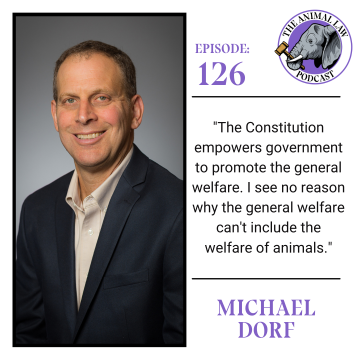
In this intellectually stimulating episode of the Animal Law Podcast, Mariann Sullivan speaks with constitutional law expert Michael Dorf about his innovative course “Animals and the Constitution.” Dorf shares how fundamental legal principles intersect with animal protection, revealing both the limitations and opportunities within our constitutional framework for advancing animal rights.
This episode explores:
- Constitutional standing for animals: How courts determine whether animals can have legal standing and the challenges of representing beings who cannot speak for themselves
- Religious freedom vs. animal protection: Analysis of Church of the Lukumi Babalu Aye v. City of Hialeah and the complex balance between First Amendment rights and preventing animal cruelty
- Free speech implications for animal advocacy: Examination of United States v. Stevens and the constitutional challenges of regulating depictions of animal cruelty
- Comparative constitutional approaches: How other countries are incorporating rights of nature and animal protections into their constitutional frameworks
- Strategic advocacy dilemmas: The difficult balance between arguing for specific animals’ rights while avoiding implications that might alarm courts
ABOUT OUR GUEST
Michael C. Dorf is the Robert S. Stevens Professor of Law at Cornell Law School, where he teaches constitutional law, federal courts, and related subjects. He has authored or co-authored six books (including, with Sherry Colb, Beating Hearts: Abortion and Animal Rights) and over one hundred scholarly articles and essays for law journals and peer-reviewed science and social science journals. His most recent work of scholarship (co-authored with Sherry Colb) is “If We Didn’t Eat Them, They Wouldn’t Exist”: The Nonidentity Problem’s Implications for Animals (Including Humans), in The American Journal of Law and Equality. He also frequently writes for the general public. In addition to occasional contributions to The New York Times, USA Today, CNN.com, The Los Angeles Times, and other wide-circulation publications, Professor Dorf has been writing a bi-weekly column since 2000 and publishes a popular blog, Dorf on Law. Dorf received his undergraduate and law degrees from Harvard. He served as a law clerk for Judge Stephen Reinhardt of the U.S. Court of Appeals for the Ninth Circuit and then for Justice Anthony M. Kennedy of the U.S. Supreme Court. He maintains an active pro bono practice mostly consisting of writing Supreme Court briefs.
We are thrilled to expand the accessibility of our podcast by offering written transcripts of the interviews! Click here to read this episode's interview.**********
You can listen to the Animal Law Podcast directly on our website (at the top of this page) or you can listen and subscribe on Apple Podcasts, YouTube, or your favorite podcatcher. Also, if you like what you hear, please rate it on Apple Podcasts, and don’t forget to leave us a friendly comment! Of course, we would be thrilled if you would consider making a donation or becoming a member of our flock (especially if you’re a regular listener). Between now and December 31, every donation up to $20,000 will be TRIPLED! Contributions of any amount will go towards our fundraising goal and are hugely appreciated. Our Hen House is a 501(c)(3) nonprofit organization, so it’s tax-deductible. Thank you for helping us create quality content!Don’t forget to also listen to the award-winning, weekly signature OHH podcast — now in its fifteenth glorious year!
28 November 2025, 10:00 am - 49 minutes 13 secondsThe Case of the Overlooked Law: Challenging Animal Confinement Through Forgotten Legislation

Attorneys Will Lowrey (Animal Partisan) and Jessica Blome (Greenfire Law) join Mariann to discuss their battle to use California’s century-old animal protection laws to help dairy calves confined in tiny hutches. Despite having clear evidence that a dairy farm was violating Penal Code Section 597t by denying calves adequate exercise, they encountered a frustrating maze of procedural obstacles that prevented them from obtaining a search warrant under Section 599a.
This episode explores:
- How a 120-year-old California law requiring exercise for confined animals, including farmed animals, is being systematically unenforced
- The procedural barriers that prevent animal advocates from using existing legal tools to help farmed animals
- How courts effectively nullify animal protection laws without legislative input
- How the dairy industry confines calves in violation of California law with impunity
- The creative legal strategies being developed to overcome institutional resistance to animal protection cases
ABOUT OUR GUESTS
Will Lowrey is the founder and Legal Counsel for Animal Partisan, a legal advocacy organization focused on challenging unlawful conduct in animal agriculture and experimentation. Will has engaged in numerous lawsuits, as well as criminal and administrative enforcement actions against the government, industrial agriculture, and research laboratories, including cases involving federal slaughter laws, public records, false advertising, public nuisance, animal cruelty, and others. Prior to his current role, Will worked for another animal protection nonprofit where he divided his time between civil litigation and providing counsel for undercover investigations. Will currently teaches Animal Law at the University of Oklahoma College of Law and has also taught at Vermont Law and Graduate School and the University of St. Thomas School of Law.
Jessica Blome, a Shareholder of Greenfire Law, P.C. in Berkeley, California, is an animal, environmental, open government, and land use attorney with nearly 20 years of experience in complex litigation. Jessica represents a wide range of clients from individuals to grassroots organizations to national non-profit organizations in cases involving the status of animals, protection of wildlife, or conservation of the environment under state, federal, and tribal law.
We are thrilled to expand the accessibility of our podcast by offering written transcripts of the interviews! Click here to read this episode's interview.**********
You can listen to the Animal Law Podcast directly on our website (at the top of this page) or you can listen and subscribe on Apple Podcasts, YouTube, or your favorite podcatcher. Also, if you like what you hear, please rate it on Apple Podcasts, and don’t forget to leave us a friendly comment! Of course, we would be thrilled if you would consider making a donation or becoming a member of our flock (especially if you’re a regular listener). Between now and December 31, every donation up to $20,000 will be tripled! Contributions of any amount will go towards our fundraising goal and are hugely appreciated. Our Hen House is a 501(c)(3) nonprofit organization, so it’s tax-deductible. Thank you for helping us create quality content!Don’t forget to also listen to the award-winning, weekly signature OHH podcast — now in its fifteenth glorious year!
31 October 2025, 9:00 am - 1 hour 10 minutesThe Case of Banning the Truth in a Public Park | First Amendment, Animal Agriculture & Free Speech

In this thought-provoking episode of the Animal Law Podcast, we dive into a First Amendment case that cuts straight to the heart of animal advocacy: can the government prevent activists from showing the public what actually happens to animals in industrial agriculture? Mariann speaks with Sara Berinhout of FIRE (Foundation for Individual Rights and Expression) and John Greil of the University of Texas Law School’s Law and Religion Clinic about their representation of Daraius Dubash and Dr. Faraz Harsini. These dedicated animal advocates were arrested and threatened with arrest, respectively, for conducting a peaceful “Cube of Truth” demonstration in Houston’s Discovery Green park. Their crime? Simply showing silent documentary footage of standard farming practices. The case raises profound questions about whether the government can delegate its constitutional obligations to private entities, whether religious motivations for animal advocacy deserve special protection, and most importantly, whether the truth about animal agriculture is too disturbing to be seen in public spaces—even as those same spaces host barbecue festivals celebrating the end products of that system.
Key Points
- First Amendment and Animal Advocacy: The case challenges whether showing footage of standard factory farming practices is protected speech in public parks.
- Religious Freedom for Animal Activists: Daraius Dubash’s Hindu practice of ahimsa (non-violence) makes his animal advocacy a constitutionally protected religious expression.
- Public Parks and Free Speech: The lawsuit questions whether local governments can evade First Amendment obligations by delegating management of public spaces to private entities.
- Content-Based Censorship: Park officials explicitly prohibited the silent documentary footage (from the film Dominion) because of its content while allowing other forms of protest.
- The Paradox of Legal Cruelty: The government’s own characterization of the footage as showing “torture” highlights the contradiction—they acknowledge the fact that the footage communicates to viewers the disturbing nature of common practices while preventing the public from seeing them.
ABOUT OUR GUESTS
Sara Berinhout is a First Amendment attorney at FIRE (Foundation for Individual Rights and Expression), bringing expertise in constitutional law and free speech defense. A Harvard Law School magna cum laude graduate who clerked for Judge James C. Ho of the Fifth Circuit Court of Appeals, Berinhout previously practiced appellate litigation at Ropes & Gray LLP, where she specialized in complex civil litigation and white-collar defense, giving her unique insight into government restrictions on protected speech and religious expression in public forums.
John Greil is a Clinical Professor of Law who co-teaches the Law and Religion Clinic at the University of Texas School of Law, specializing in First Amendment religious liberty cases and constitutional litigation. A Harvard Law School graduate and former clerk for Chief Judge Jennifer Walker Elrod of the Fifth Circuit Court of Appeals, Greil’s expertise in religious freedom law has been featured in the Wall Street Journal, Religion News Service, and Texas Public Radio, making him a leading authority on the intersection of religious practice and animal advocacy under the Free Exercise Clause.
We are thrilled to expand the accessibility of our podcast by offering written transcripts of the interviews! Click here to read this episode's interview.**********
You can listen to the Animal Law Podcast directly on our website (at the top of this page) or you can listen and subscribe on Apple Podcasts, YouTube, or your favorite podcatcher. Also, if you like what you hear, please rate it on Apple Podcasts, and don’t forget to leave us a friendly comment! Of course, we would be thrilled if you would consider making a donation or becoming a member of our flock (especially if you’re a regular listener). Contributions of any amount will go towards our fundraising goal and are hugely appreciated. Our Hen House is a 501(c)(3) nonprofit organization, so it’s tax-deductible. Thank you for helping us create quality content!Don’t forget to also listen to the award-winning, weekly signature OHH podcast — now in its fifteenth glorious year!
26 September 2025, 9:00 am - 1 hour 7 minutesAnimal Law Breakthrough: Court Recognizes Dogs as Family Members with Christopher Berry

This episode of the Animal Law Podcast features Christopher Berry, Executive Director of the Nonhuman Rights Project, discussing a groundbreaking court case that recognizes companion animals as family members in certain legal contexts. Mariann and Christopher explore how this New York decision challenges decades of precedent that treated beloved pets as mere property rather than family, potentially opening new doors for animal legal rights.
This episode explores:
- The absurd legal status of companion animals in tort law, including a Texas case where a taxidermied dog would receive more legal protection than a living one
- The facts of a landmark New York case involving a family dog killed in a crosswalk accident
- How courts are beginning to recognize companion animals as family members in negligent infliction of emotional distress claims
- The perverse incentives created by current laws that often make it “better” to kill than injure an animal
- The broader implications for animal rights and the Non-Human Rights Project’s work on procedural rights for animals
This compelling conversation highlights how the legal system’s treatment of companion animals reflects deeper inequities in our relationship with all animals, and how common law evolution can help change the world for animals through the legal system.
ABOUT OUR GUEST

Christopher Berry is Executive Director of the Nonhuman Rights Project, where he leads the organization’s groundbreaking legal effort to secure fundamental legal rights for nonhuman animals. Before joining the NhRP in 2024, he spent over a decade at the Animal Legal Defense Fund focusing on civil enforcement of animal protection laws and elevating animal legal status through strategic litigation.
We are thrilled to expand the accessibility of our podcast by offering written transcripts of the interviews! Click here to read this episode's interview.**********
You can listen to the Animal Law Podcast directly on our website (at the top of this page) or you can listen and subscribe on Apple Podcasts, YouTube, or your favorite podcatcher. Also, if you like what you hear, please rate it on Apple Podcasts, and don’t forget to leave us a friendly comment! Of course, we would be thrilled if you would consider making a donation or becoming a member of our flock (especially if you’re a regular listener). Contributions of any amount will go towards our fundraising goal and are hugely appreciated. Our Hen House is a 501(c)(3) nonprofit organization, so it’s tax-deductible. Thank you for helping us create quality content!Don’t forget to also listen to the award-winning, weekly signature OHH podcast — now in its fifteenth glorious year!
29 August 2025, 9:00 am - 55 minutes 19 secondsChallenging “Alligator Alcatraz”: The Legal Fight to Protect the Everglades with Elise Bennett

In this compelling episode, Mariann Sullivan speaks with Elise Bennett, Senior Attorney at the Center for Biological Diversity, about the lawsuit challenging the controversial immigration detention facility in Florida’s Everglades. Bennett details how this hastily constructed center in Big Cypress National Preserve threatens endangered species, water quality, and the integrity of a crucial ecosystem that has received billions in restoration funding over decades. The case hinges on federal agencies’ failure to conduct required environmental impact assessments under the National Environmental Policy Act (NEPA), highlighting how environmental laws may protect wildlife habitats even in politically charged circumstances.
This episode explores:
- How the facility threatens endangered Florida panthers (only 120-230 remain in the wild) and the endemic Florida bonneted bat
- Environmental impacts including artificial lighting visible from 15 miles away and even from space
- Legal strategies using NEPA to challenge federal agencies’ failure to assess environmental impacts
- Complex jurisdictional questions as state and federal agencies attempt to evade accountability
- Potential water contamination risks in an ecosystem that’s critical to Florida’s environmental health
ABOUT OUR GUEST

Elise Bennett is the Florida and Caribbean director and a senior attorney at the Center for Biological Diversity. She advocates for endangered species and wild places in Florida and the Caribbean. Born and raised in Florida, she holds a law degree and a certificate of concentration in environmental law from Stetson University College of Law, as well as a bachelor’s degree in environmental science and policy from the University of South Florida. Before joining the Center’s Florida and Caribbean program, Elise focused on protecting rare amphibians and reptiles in the eastern United States.
We are thrilled to expand the accessibility of our podcast by offering written transcripts of the interviews! Click here to read this episode's interview.**********
You can listen to the Animal Law Podcast directly on our website (at the top of this page) or you can listen and subscribe on Apple Podcasts, YouTube, or your favorite podcatcher. Also, if you like what you hear, please rate it on Apple Podcasts, and don’t forget to leave us a friendly comment! Of course, we would be thrilled if you would consider making a donation or becoming a member of our flock (especially if you’re a regular listener). Contributions of any amount will go towards our fundraising goal and are hugely appreciated. Our Hen House is a 501(c)(3) nonprofit organization, so it’s tax-deductible. Thank you for helping us create quality content!Don’t forget to also listen to the award-winning, weekly signature OHH podcast — now in its fifteenth glorious year!
25 July 2025, 9:00 am - 1 hour 2 minutesRedefining Democracy: How Constitutional Law Could Embrace All Sentient Life

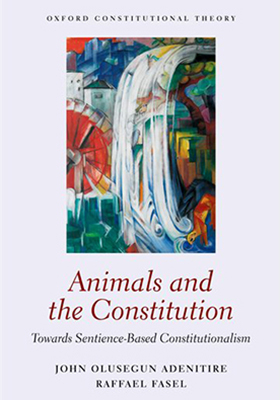
In a groundbreaking episode of The Animal Law Podcast, we explored radical new concepts that could fundamentally transform how constitutional law treats animals. Host Mariann Sullivan welcomed Cambridge University’s Raffael Fasel and Queen Mary University’s John Adenitire to discuss their book “Animals and the Constitution: Towards Sentience-Based Constitutionalism” – a work that challenges centuries of legal tradition by proposing constitutional frameworks that recognize the inherent worth of all sentient beings.
While traditional constitutions rely on the “hypothetical consent of the governed,” this revolutionary approach acknowledges that billions of sentient beings are governed by constitutional systems but have no voice in shaping them. The authors argue for a dramatic shift from anthropocentric legal structures to ones that provide “due concern” for all creatures capable of experiencing pain, pleasure, and complex emotions.
Key Discussion Points:
- The historical evolution of constitutionalism from divine right monarchy to modern democratic systems
- Why sentience, rather than rationality or autonomy, should be the foundation for constitutional worth
- How existing animal welfare protections in constitutions worldwide fall short of true recognition
- The application of proportionality principles when animal and human interests conflict
- Practical challenges of implementing constitutional rights for domesticated and wild animals
- The role of micro-boards and participatory democracy in determining animal interests
- Real-world examples from Ecuador’s rights of nature to Switzerland’s animal dignity provisions
- Why this “realistic utopia” framework offers hope for incremental progress toward comprehensive animal rights
This episode challenges listeners to reconsider fundamental assumptions about law, democracy, and moral consideration – making complex constitutional theory accessible to animal advocates seeking systemic change.
ABOUT OUR GUESTS
Dr John Olusegun Adenitire is a Senior Lecturer at Queen Mary, University of London, School of Law and a Co-Director of the Forum on Decentering the Human, an inter-disciplinary research centre. He completed his PhD in Law at Fitzwilliam College, University of Cambridge. He has held visiting research fellowships at Yale, Oxford, New York University, and Fordham University. He has published extensively on constitutional rights, discrimination law and theory, and animal rights. He teaches animal rights law, public law, legal philosophy and EU law at Queen Mary.
Dr Raffael Fasel is Assistant Professor in Public Law at Cambridge University and founding Co-Director of the Cambridge Centre for Animal Rights Law. Dr. Fasel is a leading voice in animal rights jurisprudence, holding degrees from Cambridge (PhD), Yale (LLM), UCL (MA Philosophy), and Fribourg (LLB, LLM). His award-winning research earned the prestigious Yorke Prize and SNSF Ambizione grant. Recent publications include More Equal Than Others: Humans and the Rights of Other Animals (Oxford 2024), Animal Rights Law (Hart 2023), and Animals and the Constitution (Oxford 2025). Expert in constitutional theory, human rights, and animal law with visiting positions at Harvard, Yale, Oxford, and NYU.
We are thrilled to expand the accessibility of our podcast by offering written transcripts of the interviews! Click here to read this episode's interview.**********
You can listen to the Animal Law Podcast directly on our website (at the top of this page) or you can listen and subscribe on Apple Podcasts, YouTube, or your favorite podcatcher. Also, if you like what you hear, please rate it on Apple Podcasts, and don’t forget to leave us a friendly comment! Of course, we would be thrilled if you would consider making a donation or becoming a member of our flock (especially if you’re a regular listener). Contributions of any amount will go towards our fundraising goal and are hugely appreciated. Our Hen House is a 501(c)(3) nonprofit organization, so it’s tax-deductible. Thank you for helping us create quality content!Don’t forget to also listen to the award-winning, weekly signature OHH podcast — now in its fifteenth glorious year!
27 June 2025, 9:00 am - More Episodes? Get the App